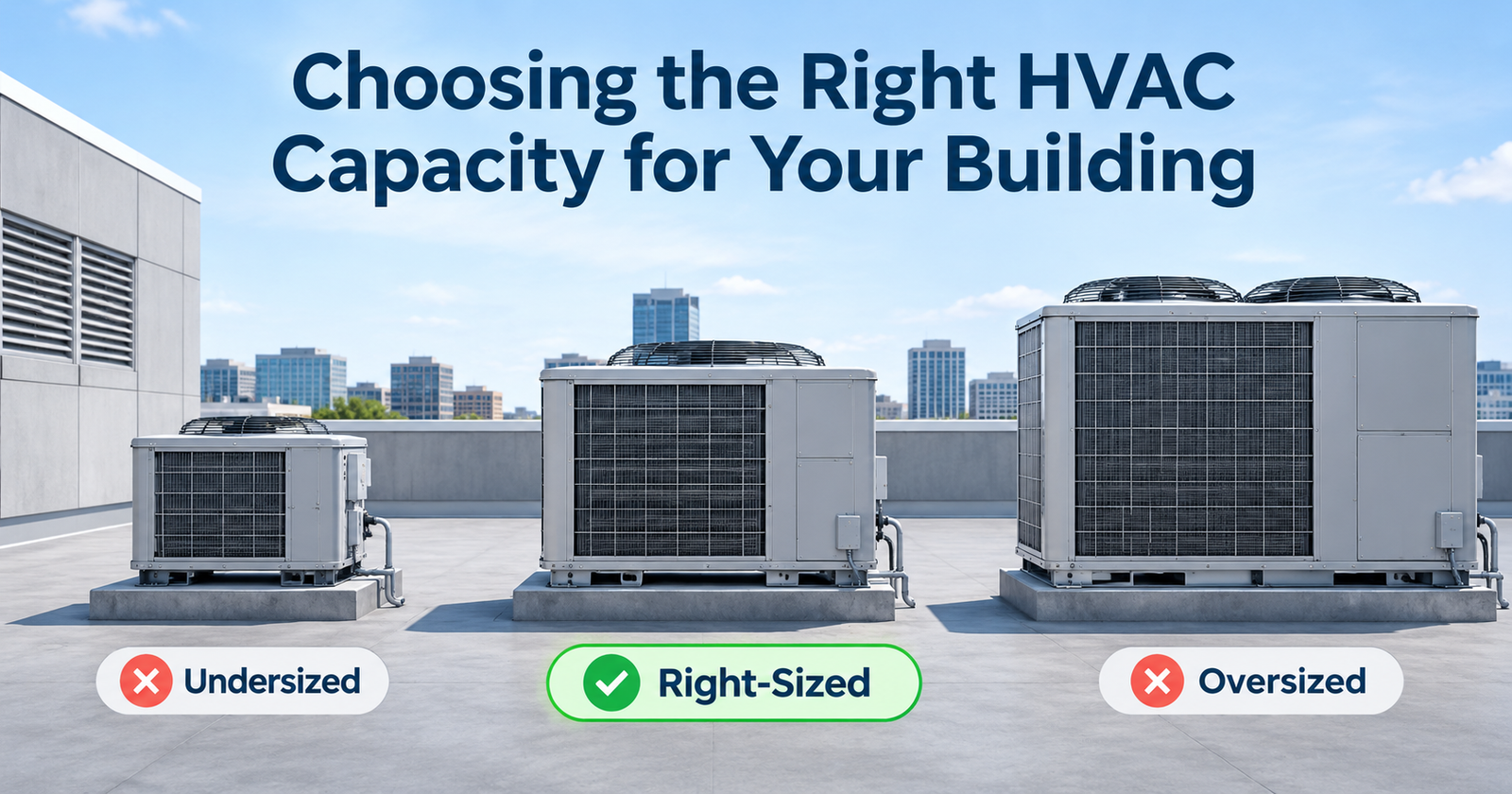
Choosing the Right HVAC Capacity for Your Building: Avoiding Oversizing and Undersizing
A guide to understanding the difference between cooling loads and cooling capacity, the effects of improper equipment sizing, and the steps required to review system capacity before approving equipment.
Choosing air conditioning equipment with a capacity greater than a building’s actual requirements may seem like a safe decision, particularly for projects operating long hours or located in regions with high outdoor temperatures.
However, higher capacity is not always the better solution. Conversely, selecting equipment with insufficient capacity may make it difficult to maintain the required design temperatures during periods of high cooling demand.
Therefore, choosing the right HVAC capacity for your building requires carefully balancing calculated cooling loads, actual equipment performance, and the facility’s operating conditions rather than relying solely on floor area or nominal capacity.
1. What Is HVAC Cooling Capacity?
HVAC cooling capacity is the rate at which an air conditioning system can remove heat from the spaces it serves under specified operating conditions.
Technical specifications typically express cooling capacity in units such as:
- Kilowatts of cooling capacity (kW): This is different from the electrical power consumed.
- British Thermal Units per Hour (BTU/h).
- Tons of Refrigeration (TR).
The nominal capacity listed in an equipment catalogue does not necessarily mean that the system will deliver the same capacity under all operating conditions.
Actual performance may vary depending on outdoor air temperature, operating temperatures, airflow, and equipment specifications.
2. What Is the Difference Between Cooling Load and Equipment Capacity?
The cooling load represents the rate at which heat must be removed to maintain the design indoor conditions in a building or zone. It includes both the sensible component and the latent component associated with humidity.
Equipment capacity, on the other hand, represents the cooling output that a unit or system can deliver under specified operating conditions.
The actual available capacity must match the load served by the unit or system. Outdoor air loads, fan heat, and other system loads must be considered according to the system configuration, while avoiding double-counting the same load.
This means equipment selection involves more than matching a calculated cooling load to a nominal capacity figure. It requires reviewing the units’ performance data under the project’s actual conditions.
3. What Happens When HVAC Capacity Is Insufficient?
When a system cannot provide the required cooling capacity under design conditions, several problems may occur, including:
- Failure to reach target temperatures during periods of high cooling loads.
- Equipment operating for extended periods near its available capacity limits.
- Certain zones being affected more than others because of differences in airflow distribution and cooling loads.
- Difficulty responding to changes in occupancy or internal heat gains.
However, these symptoms alone do not prove that the system is undersized. They may also result from faults in controls, equipment, or the air distribution network.
Therefore, actual available capacity should be verified before deciding to increase system capacity.
4. Why Can Oversized HVAC Equipment Be a Problem?
Selecting larger equipment may appear to provide an additional safety margin in every situation, but unjustified oversizing can affect both performance and cost.
Higher Initial Cost
Increasing equipment capacity may require larger units, electrical components, and additional connections that are not justified by the project’s actual requirements.
Operation at Low Loads
Oversized equipment may operate at a small fraction of its capacity for much of the time, potentially affecting efficiency depending on the system type and its control capabilities.
Frequent On-Off Cycling
Some systems, particularly equipment with limited capacity modulation, may experience frequent short operating cycles when cooling loads are low.
Humidity Control
Intermittent operation of certain Direct Expansion (DX) systems may affect their ability to remove moisture, depending on the system configuration and operating conditions.
However, these effects should not be generalized to all HVAC systems, as capacity modulation and control capabilities vary between technologies.
5. How to Choose the Right HVAC Capacity for Your Building
The sizing process can be organized into six connected steps.
Step 1: Use Calculated Cooling Loads
The selection process begins with the results of cooling load calculations for each zone and for the building as a whole, rather than estimates based solely on floor area.
Step 2: Determine Design Conditions
The review must establish the project’s outdoor design conditions, required indoor temperature and humidity levels, and relevant operating hours.
Step 3: Review the Timing of Cooling Loads
Not every zone in a building necessarily reaches its maximum cooling load at the same time.
Each zone’s peak load must be considered when selecting its components, while the coincident load for a shared system should be assessed using the adopted calculation method.
Using load diversity does not mean allowing a zone to receive insufficient cooling when it reaches its own peak load.
Step 4: Match Equipment Performance to Project Conditions
Manufacturer performance data must be reviewed under the relevant operating conditions rather than relying only on nominal capacity.
Performance adjustments vary according to the technology.
For VRF systems, the manufacturer’s selection data should be used to review temperatures, refrigerant piping lengths, elevation differences, and connected indoor-unit capacity ratios.
For Chiller systems, relevant selection factors include chilled water temperatures, water flow rates, heat rejection conditions, and other applicable operating parameters.
The equipment selection must be verified against both total cooling capacity and sensible cooling capacity requirements. The system’s ability to handle latent loads and control humidity must also be confirmed.
Matching the total cooling capacity figure alone is not sufficient.
Step 5: Review Air Distribution and System Requirements
Fans, ductwork networks, and other distribution components must be capable of serving the required zones.
Having adequate cooling capacity available at the equipment does not necessarily mean that conditioned air reaches every space in the appropriate quantity.
Step 6: Evaluate Part-Load Performance
Many facilities operate below their design cooling load for significant portions of their operating hours.
The selection process should therefore consider the system’s ability to respond to changing loads, its control requirements, and the effects on performance and efficiency.
An Example: Reviewing an Equipment Proposal
Suppose the required total cooling load at the equipment selection point is 100 kW, and a proposed unit has a nominal capacity of 110 kW.
If the manufacturer’s selection data show that the unit’s available capacity under the project’s operating conditions is only 95 kW, the unit does not meet the required cooling load, even though its nominal capacity is higher.
An alternative unit that meets the required total cooling capacity should still not be approved until its sensible cooling capacity, humidity control capability, air distribution requirements, and control requirements have also been verified.
These figures are hypothetical and are provided only to explain the concept. They do not represent a fixed capacity correction factor or a valid equipment selection for an actual project.
6. Do Buildings in Saudi Arabia Always Need Higher HVAC Capacity?
Saudi Arabia’s climatic conditions affect cooling load calculations and equipment selection, particularly in locations with high outdoor temperatures.
However, this does not justify adding a fixed percentage to cooling capacity without an engineering basis.
The appropriate approach is to use climate design data representative of the project location, review equipment performance under those conditions, and determine the required capacity from the results.
Thermal insulation, glazed façades, ventilation, occupancy patterns, and heat generated by internal equipment must also be considered.
Increasing capacity simply because a region experiences high temperatures is not a substitute for proper engineering calculations.
Selection Margin, Redundancy, and Future Expansion: What Is the Difference?
Selection margin is the justified difference between the approved cooling load and the capacity of the available equipment size. It should be documented, and the accumulation of unjustified margins should be avoided.
Redundancy for service continuity involves providing alternative operating capacity when a unit fails or requires maintenance. All redundant capacity does not necessarily need to operate under normal conditions.
Future expansion should be based on a defined requirement. It may be planned through phased equipment additions, with the necessary infrastructure prepared in advance.
7. What Documents Should Be Reviewed Before Approving HVAC Capacity?
When reviewing an HVAC design or equipment proposal, the following information should be available:
- Cooling load calculation report and the assumptions used.
- Outdoor and indoor design conditions.
- Design cooling loads for each zone.
- Total required system load.
- Performance data for the proposed equipment.
- Actual available capacity under project conditions.
- Required airflow rates.
- Control and part-load operating requirements.
- Any modifications related to future expansion.
These documents provide a stronger basis for comparing technical proposals and reviewing decisions before installation.
8. How Can Cool Saif Help Review HVAC Equipment Selection?
Cool Saif connects HVAC capacity selection with project requirements and engineering assessment results.
Depending on the agreed scope of work, the review may include cooling load reports, equipment selection data, operating conditions, and air distribution and control components.
The objective is to help project owners compare technical proposals based on available capacity and expected performance, alongside operating and maintenance requirements.
Conclusion
Insufficient cooling capacity may prevent a building from meeting its cooling requirements during high-load periods, while excessive capacity can lead to additional costs or unsuitable part-load performance, depending on the system type.
Choosing the right HVAC capacity for your building begins with calculating cooling loads, followed by reviewing design conditions, equipment performance data, and air distribution and control requirements.
Need to Review the HVAC Capacity for Your Project?
The Cool Saif team can discuss your facility’s requirements and the technical factors that should be verified before approving equipment or upgrading an existing system.
Cool Saif Air Conditioning and Refrigeration Services
Frequently Asked Questions
Does Higher HVAC Capacity Always Mean Better Cooling?
Not always. Performance depends on matching equipment capacity to cooling loads, equipment characteristics, controls, and air distribution.
Can HVAC Capacity Be Determined from Building Floor Area Alone?
No. Floor area alone is insufficient. Cooling loads, façades, insulation, occupancy, ventilation, and equipment must also be considered.
What Is the Difference Between Nominal and Actual Cooling Capacity?
Nominal capacity is declared under specified test conditions, while actual performance depends on project operating conditions and equipment specifications.
Should Every Project Include Additional Reserve Capacity?
There is no single percentage suitable for every project. Reserve capacity or operational redundancy should be determined according to the project’s characteristics, requirements, and required level of service continuity rather than by arbitrarily increasing capacity.
Technical References
ASHRAE — Nonresidential Cooling and Heating Load Calculations