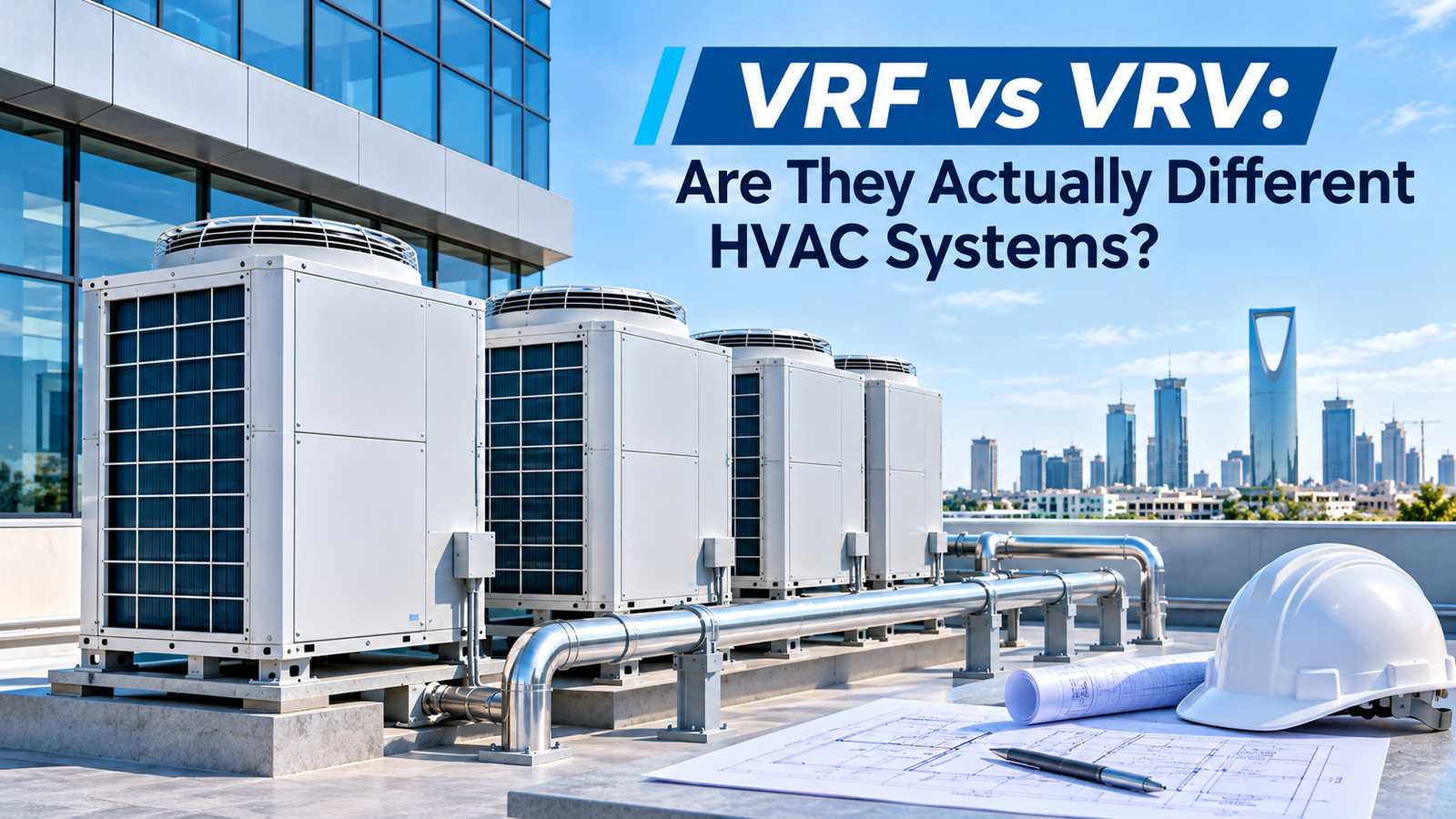
VRF vs VRV: Are They Actually Different HVAC Systems?
When searching for an air conditioning system for offices or commercial buildings, terms such as VRF and VRV may appear in equipment catalogues and technical proposals. Project owners may assume that each term refers to a completely different technology.
However, the main distinction in VRF vs VRV is related to commercial terminology. Both terms describe technology that controls refrigerant flow according to the cooling or heating requirements of the zones being served.
For projects in Saudi Arabia, it is more important to compare actual equipment specifications, installation requirements, control capabilities, and maintenance needs than to make decisions based on terminology alone.
1. What Does VRF Mean?
Variable Refrigerant Flow (VRF) refers to technology that varies refrigerant flow to meet changing system demand.
A typical system includes one or more interconnected outdoor units, indoor units serving different zones, refrigerant piping, and control systems.
The system adjusts its operating capacity according to zone demand and design limitations, allowing cooling requirements to be managed across multiple areas.
However, this does not mean that all VRF products provide identical performance or control features.
2. What Does VRV Mean?
Variable Refrigerant Volume (VRV) is a designation used by Daikin for its systems within this technology category.
According to the manufacturer, VRV is a registered trademark of Daikin, while VRF is the generic term used for variable refrigerant flow technology.
Therefore, VRV and VRF are not separate categories in terms of their fundamental operating principle. However, products from different manufacturers may vary in specifications, capacities, and features.
A project owner may receive a proposal for a Daikin VRV system and another for a VRF system from a different manufacturer. In that case, the comparison should focus on equipment capacity, efficiency, controls, installation requirements, and warranty coverage. The difference in terminology alone is not enough to determine which proposal is better.
3. Are There Actual Differences Between VRF and VRV Products?
Yes. Important differences may exist between products, but they cannot be determined solely by the terminology used.
Available Capacity Under Project Conditions
Equipment capacity must be reviewed at the project’s outdoor design temperatures rather than relying only on nominal ratings.
Refrigerant Piping Lengths and Elevation Differences
Each system has specific installation requirements and limitations for refrigerant piping, branch connections, and elevation differences.
Available capacity may also be affected by correction factors specified by the manufacturer.
Indoor Unit Connection Ratio
The indoor unit connection ratio is the ratio of the combined nominal capacities of the indoor units to the nominal capacity of the outdoor unit.
It must be evaluated within the manufacturer’s permitted limits, considering coincident cooling loads and the actual available capacity.
The approved limits for connecting indoor units to outdoor units, load coincidence, and unit selection methods must also be verified.
Controls and Zone Management
Scheduling, monitoring, unit management, centralized controls, and integration with building systems may differ depending on the selected model and configuration.
Cooling, Heating, and Heat Recovery
Cooling and heating capabilities vary according to system type.
Certain heat recovery systems allow some zones to be cooled while others are heated simultaneously, depending on the system design and selected model.
These features should not be assumed to be available simply because a system is called VRF or VRV.
Energy Efficiency and Operating Costs
Energy efficiency data should be compared under equivalent testing conditions.
Part-load performance must also be reviewed, taking into account climate conditions and operating hours.
It should not be assumed that all products in this technology category have the same energy consumption.
4. How Do You Choose a Suitable System for a Commercial Building?
The evaluation begins with cooling load calculations and the requirements of each zone.
The locations of outdoor and indoor units are then determined, along with refrigerant piping routes, ventilation, drainage, electrical connections, and control requirements.
Suppliers should provide clear equipment selection data, including:
- Proposed equipment models and capacities.
- Available cooling capacity under project conditions.
- Refrigerant piping diagrams, branch connections, and piping length limits.
- Indoor unit connection requirements and control methods.
- Maintenance requirements and equipment accessibility.
- Technical documentation, warranties, and after-sales services.
The ventilation system must also provide the required outdoor air, either independently or through an integrated arrangement, according to the design.
Installing a VRF system does not automatically mean that the building’s ventilation requirements have been satisfied.
5. What Matters for Projects in Saudi Arabia?
In Saudi Arabia, appropriate climatic design conditions must be established for each project, and outdoor unit performance must be evaluated under those conditions.
The review should also consider equipment ventilation clearances, maintenance and cleaning requirements, refrigerant piping length limits, and the availability of technical support and spare parts.
Building activities and operating hours may influence the suitability of the system. Therefore, the selection should not be based solely on the brand name.
Refrigerant and piping safety requirements must also be reviewed in accordance with the regulations and technical specifications applicable to the project.
6. When Might VRF Not Be the Best Option?
No HVAC system is suitable for every application.
Some projects may require a central chilled-water system, Package Units, or another solution based on cooling loads, distribution requirements, ventilation, maintenance, and operational continuity.
When comparing a chilled-water system with Direct Expansion (DX) systems, project requirements, operating costs, maintenance, and future expansion should be evaluated alongside the initial investment.
7. Do VRF and VRV Systems Have the Same Cost?
System prices cannot be evaluated based on terminology alone.
Costs depend on the number and capacities of the units, refrigerant piping lengths, electrical works, controls, ventilation, initial startup, warranty coverage, and associated services.
8. What Are the Common Mistakes When Evaluating VRF and VRV?
- Assuming that different names indicate completely different technologies.
- Selecting equipment based on nominal capacity without reviewing performance correction factors.
- Ignoring refrigerant piping limitations, elevation differences, and connection ratios.
- Overlooking ventilation requirements and outdoor air treatment.
- Comparing prices without aligning piping, controls, and startup requirements.
- Failing to define warranty, maintenance, and technical support requirements.
Documenting these points helps identify the proposal that best meets the project’s needs.
Cool Saif’s Role in Selecting the Right System
Planning to select an HVAC system for your building? Contact Cool Saif to review cooling loads, operating requirements, and suitable technical alternatives, while clearly defining the scope of supply, installation, controls, and maintenance.
The scope of the study and services depends on the project information and agreed requirements.
Contact Cool Saif in Riyadh: 0535898340
Conclusion
The distinction in VRF vs VRV does not represent a fundamental difference in the refrigeration principle. VRV is a commercial designation used by Daikin, while VRF is the generic term for the technology.
The differences worth evaluating are found in product features, available capacity, controls, installation limitations, costs, and technical support.
Frequently Asked Questions
Is VRV a Completely Different Technology from VRF?
No. Both terms refer to the same general technology, with VRV being a trademarked designation.
Do All VRF Systems Support Heat Recovery?
No. This feature depends on the system model and configuration.
Can a System Be Selected Based on the Catalogue Alone?
Nominal capacity data is not sufficient. Site conditions, piping limitations, connection ratios, controls, and ventilation requirements must also be reviewed.