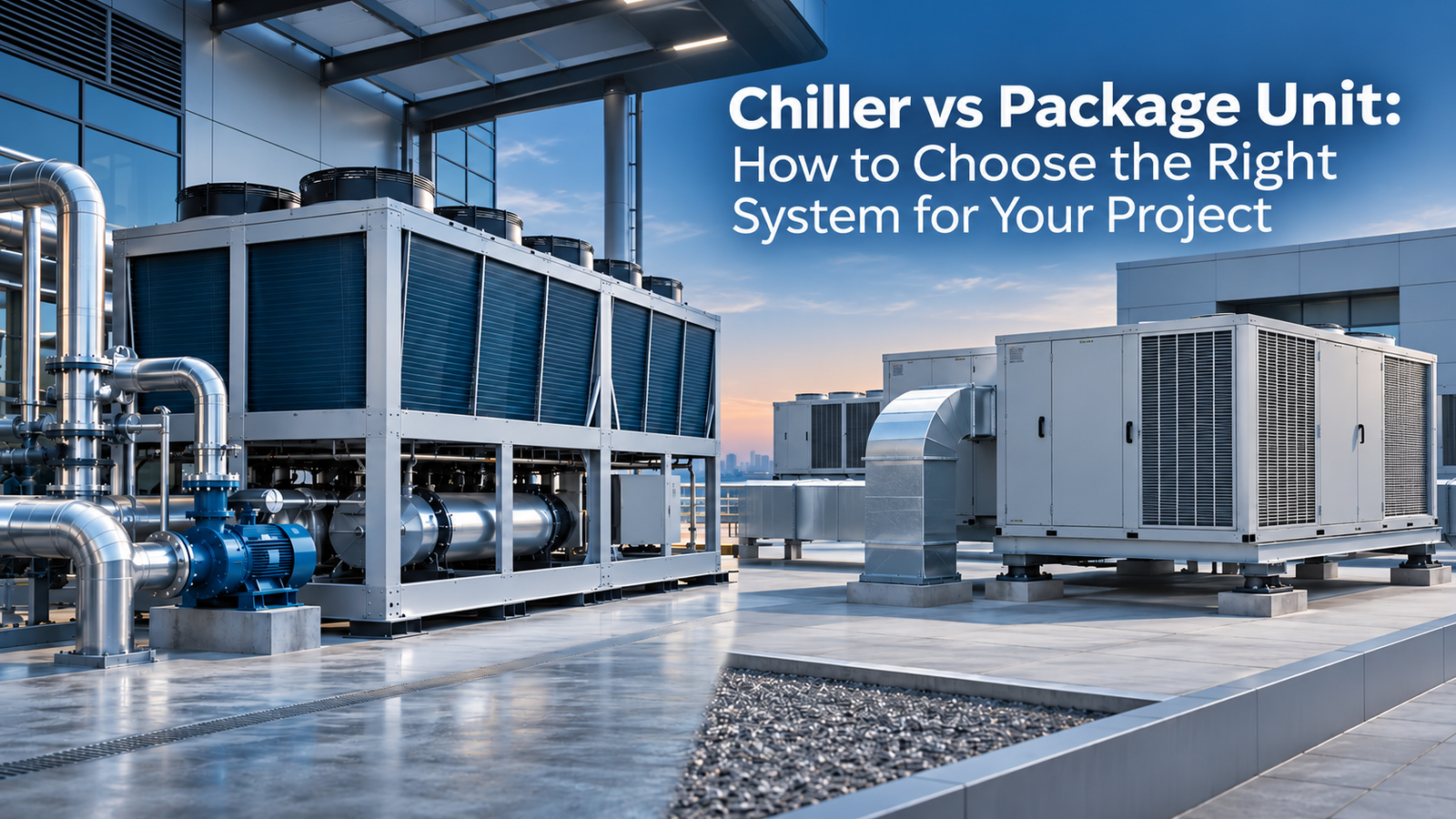
Chiller vs Package Unit: How to Choose the Right System for Your Project
When planning the air conditioning system for a commercial building, project owners may find themselves choosing between two different options: a Chiller system or Package Units. The decision depends on more than the building’s floor area. Cooling distribution methods, building use, available equipment space, and operation and maintenance requirements all influence the selection.
Understanding Chiller vs Package Unit systems helps determine whether a project requires a central chilled-water system or packaged air conditioning units serving designated spaces.
For projects in Saudi Arabia, the comparison should be based on site conditions, the proposed equipment, and the facility’s requirements rather than assuming that either system is always better.
1. How Does a Chiller System Work?
A Chiller cools water used to transport cooling to equipment inside a building, such as Air Handling Units (AHUs) and Fan Coil Units (FCUs).
A chilled-water system typically includes:
- One or more Chillers.
- Chilled-water pumps and a piping network.
- Air Handling Units or terminal units.
- Control valves, control systems, and balancing devices.
- Heat rejection components appropriate for the Chiller type.
A Chiller may be air-cooled or water-cooled. Heat rejection arrangements differ between these configurations. A water-cooled Chiller typically uses a condenser-water circuit and a cooling tower or another suitable method of heat rejection.
One advantage of this arrangement is its ability to serve multiple zones through a shared chilled-water system. However, this requires an integrated engineering assessment of water flow, controls, operation, and maintenance.
2. How Do Package Units Work?
Package Units are factory-assembled air conditioning systems containing the main components of a Direct Expansion (DX) refrigeration cycle within an integrated unit or assembly, depending on the design.
Many commercial Package Units are installed on rooftops or in suitable outdoor locations and connected to ductwork that supplies conditioned air to the areas they serve.
A packaged system may include:
- One or more Package Units.
- Supply and return air ductwork and air outlets.
- Electrical connections and controls.
- Ventilation or outdoor air arrangements according to project requirements.
A conventional Package Unit does not require a chilled-water network to deliver cooling to the air coil because cooling is provided through the refrigerant circuit inside the unit.
However, this does not eliminate the need for proper air distribution, ventilation, and control design.
3. Chiller vs Package Unit: A Technical Comparison of the Main Differences
To understand the differences between these systems, it is useful to examine how cooling is produced and transported within the building, followed by installation, control, maintenance, and future expansion requirements.
First: How Cooling Is Delivered to Indoor Spaces
Chiller System: Water is cooled inside the Chiller and transported through a piping network to Air Handling Units or terminal units, which then cool the air serving the building’s zones.
Package Units: Air is cooled using a Direct Expansion (DX) refrigeration cycle inside the unit and distributed to the required spaces through ductwork.
Key Difference: A Chiller system uses chilled water to transport cooling, while conventional Package Units distribute conditioned air directly from the unit.
Second: Distribution Network Components
Chiller System: The system requires chilled-water pumps, piping, valves, and terminal units, along with the other components necessary for operation and control.
Package Units: The distribution network typically consists of ductwork, fans, supply outlets, and return air paths, together with the required electrical, control, and ventilation works.
Key Difference: The systems require different types of distribution infrastructure and supporting equipment, affecting design, installation space, and the scope of work.
Third: System Arrangement and Operation
Chiller System: Cooling production can be centralized in a shared plant serving multiple areas within the building.
Package Units: Air conditioning can be provided by one or more relatively independent units, with each unit serving the areas specified in the design.
Key Difference: A Chiller system can use a shared central cooling plant, while Package Units allow cooling production to be distributed among separate packaged systems according to building requirements.
Fourth: Temperature Control Across Different Zones
Chiller System: Temperature control depends on terminal units, valves, sensors, and the selected control system, allowing cooling to be regulated according to each zone’s requirements.
Package Units: Temperature control depends on the number of units installed, zoning arrangements, air distribution design, and available control capabilities.
Key Difference: Both systems can be designed to provide zone control, but the equipment and methods used to achieve it differ.
Fifth: Maintenance Requirements
Chiller System: Maintenance includes the Chiller, pumps, water networks, valves, terminal units, and heat rejection components, depending on the system configuration.
Package Units: Maintenance focuses on the packaged air conditioning units and their components, fans, filters, ductwork, controls, and associated drainage systems.
Key Difference: Neither system can automatically be considered easier to maintain without reviewing equipment quantity, arrangement, accessibility, and the resources required for servicing.
Sixth: Future Expansion and System Modifications
Chiller System: Expansion capabilities depend on the available capacity of the central plant, pumps, piping, terminal units, and control systems.
Package Units: Expansion depends on the availability of additional installation locations, electrical supply capacity, air distribution possibilities, and coordination of operation and controls.
Key Difference: Both systems may allow future expansion, but each has specific requirements that should be considered during the design stage.
What Do These Differences Mean When Selecting a System?
Comparing Chiller and Package Unit components alone is insufficient to determine which system is better.
The selection must consider cooling loads, zone characteristics, available space, ventilation requirements, initial costs, energy consumption, and maintenance.
Therefore, the technical comparison is a starting point for evaluating alternatives. It does not replace cooling load calculations or the verification of equipment performance under actual project design conditions.
For a broader understanding of the selection process, explore the commercial building air conditioning guide.
4. When Is a Chiller Worth Considering?
A Chiller system may be worth considering when:
- The building contains multiple zones with different operating requirements.
- The project requires cooling to be distributed from a shared plant to separate spaces.
- Sufficient space and infrastructure are available for the central plant, pumps, and piping.
- A centralized operation and control strategy is required.
- The facility can support the maintenance and management requirements of the system.
However, building size alone is not sufficient justification for choosing a Chiller. Initial costs, energy use, water requirements, maintenance, and part-load performance must also be evaluated.
5. When Are Package Units a Suitable Option?
Package Units may be worth considering when the building’s zones can be served by relatively independent units, suitable installation locations and duct routes are available, and a central chilled-water system is not required.
Installing multiple units may also make it easier to distribute operational responsibilities across different building zones. However, the decision depends on ventilation design, duct lengths, noise, control capabilities, and installation costs.
It is also useful to understand other alternatives. The VRF vs Package Unit comparison explains another important difference between commercial air conditioning systems.
6. What Should Be Considered for Projects in Saudi Arabia?
When carrying out a project in Saudi Arabia, the site’s outdoor design conditions affect air conditioning equipment performance and the selection of heat rejection components.
The comparison should include a review of:
- Actual equipment capacity at the applicable design temperatures.
- Ventilation around outdoor units and required service clearances.
- Maintenance access to rooftops and mechanical rooms.
- Outdoor air conditions and cleaning and filtration requirements.
- Water treatment and maintenance requirements when a condenser-water system is used.
Relevant requirements of the Saudi Mechanical Code and nonresidential building energy efficiency regulations should also be considered.
A fixed percentage of additional cooling capacity should not be applied simply because a project is located in a hot climate. Cooling loads and equipment selection conditions must be reviewed for each site.
7. How Should the Costs of Both Systems Be Compared?
The comparison should not be limited to the purchase price of a Chiller or Package Unit.
A fair assessment includes equipment costs, supply, distribution infrastructure, electrical works, controls, installation, testing, maintenance, and expected energy consumption.
The proposed alternatives should also be compared using equivalent cooling loads, indoor conditions, ventilation requirements, and reliability expectations.
This subject is discussed further in the article on Commercial HVAC Installation Cost in Saudi Arabia, which explains the cost components that should be included before requesting a quotation.
For additional considerations beyond price, review the factors that influence HVAC system selection.
8. Is There a Third Alternative to Chillers and Package Units?
Yes. A VRF system may be worth considering for certain projects, particularly when the building includes multiple operating zones requiring independent temperature control.
However, technology should not be selected based on its name alone.
To understand the difference between the two terms commonly used for this category of systems, see the article VRF vs VRV: Are They Actually Different HVAC Systems?
9. What Documents Should Be Reviewed Before Approving a System?
Before approving either system, it is recommended to review cooling load calculations, distribution drawings, equipment performance data, ventilation requirements, electrical and control drawings, maintenance clearances, and testing and handover requirements.
Contractor proposals should then be compared against a consistent scope of work. A lower price may result from excluding necessary work rather than offering a superior technical solution.
The article Comparing HVAC Contractor Quotes explains how to approach this evaluation.
Reviewing these requirements before approval can also help reduce potential commercial air conditioning challenges during building operation.
How Can Cool Saif Help You Choose the Right System?
Cool Saif provides engineering studies, design, supply, installation, and maintenance services for air conditioning and refrigeration systems according to project requirements and the agreed scope of work.
Chiller systems, Package Units, and other alternatives can be discussed after identifying the facility’s cooling loads, operating requirements, available space, and technical documentation.
Conclusion
The main distinction in Chiller vs Package Unit systems lies in how cooling is produced and distributed, the components involved, and the associated operation and maintenance requirements.
Neither option is automatically better for every facility.
The appropriate decision begins with identifying the building’s cooling loads and operational needs, followed by evaluating the available alternatives according to project conditions and total costs.
Planning a Commercial HVAC Project in Saudi Arabia?
If you are evaluating a Chiller or Package Unit system, discuss your building’s requirements, available space, and operating needs with Cool Saif before finalizing the equipment selection.
Frequently Asked Questions
Is a Chiller Always More Efficient Than a Package Unit?
No. Efficiency depends on equipment type, cooling loads, distribution, controls, and operating conditions. A technical comparison is required before drawing a conclusion.
Does Every Chiller Require a Cooling Tower?
No. Air-cooled and water-cooled Chillers use different heat rejection arrangements.
Are Package Units Suitable for Multi-Story Buildings?
They may be suitable for certain applications, depending on equipment locations, ductwork routes, and the requirements of different building zones.