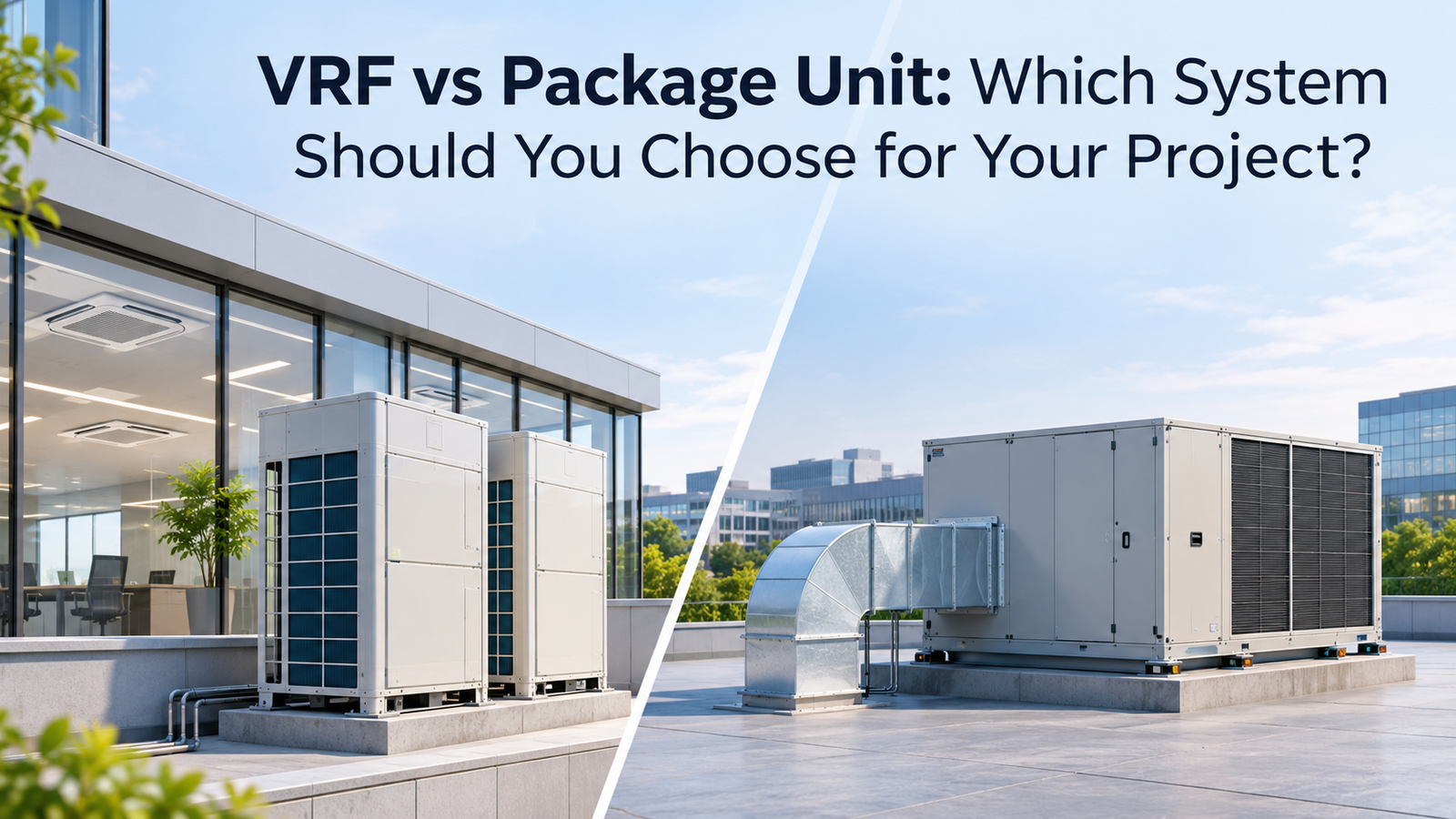
VRF vs. Package Unit: When Should You Choose Each System for Your Project?
A Practical Guide to Understanding How Each System Works, Temperature Control, Air Distribution, Energy Efficiency, and Suitable Applications.
Key Takeaway Before We Begin
There is no single air conditioning system that is best for every project.
Choosing between VRF and Package Unit systems should be based on cooling loads, the nature of the spaces, the required level of temperature control, ventilation requirements, operating hours, budget, and ease of maintenance.
Introduction
VRF and Package Unit systems are among the commonly used solutions in commercial and service-sector HVAC projects, as well as certain industrial applications. However, the differences between these systems extend beyond their equipment configurations. They also involve how cooling is delivered, control mechanisms, air distribution, and the types of spaces each system is designed to serve.
Flexible temperature control across multiple zones may be a priority in an office building or hotel. In contrast, a packaged air conditioning unit that supplies a large area through ductwork may be a suitable solution for a showroom, warehouse, or operational facility.
Therefore, the selection should not be based solely on price or the name of the technology. The right decision begins with evaluating cooling loads, occupancy patterns, outdoor air and ventilation requirements, distribution routes, and expected operating efficiency.
1. What Is a VRF System and How Does It Work?

VRF stands for Variable Refrigerant Flow, an air conditioning system that regulates refrigerant flow according to cooling or heating demand.
The system connects one or more outdoor units to multiple indoor units through a network of refrigerant piping. Its control systems regulate refrigerant flow based on the thermal demand of the zones served.
This configuration allows indoor units to be distributed across multiple rooms or zones, with the ability to control temperatures relatively independently in each zone, depending on the system’s design and capabilities.
Key Features of VRF Systems
- Flexible zone control: Suitable for buildings where operating hours or cooling loads vary between rooms and zones.
- Variety of indoor units: Cassette, wall-mounted, concealed, and other indoor unit types can be selected according to interior design requirements.
- Demand-based refrigerant flow regulation: May improve performance under part-load conditions when the system is properly designed and configured.
- Cooling and heating capabilities: Some systems support heating, while certain heat recovery configurations may allow simultaneous cooling and heating in different zones.
Important Considerations When Selecting a VRF System
- Determine indoor and outdoor unit capacities based on actual calculated cooling loads.
- Ensure the system is suitable for the number of zones requiring independent temperature control.
- Consider refrigerant-related safety requirements and room volumes in accordance with applicable standards.
- Verify that the system provides the control capabilities required by the building.
- Do not automatically consider VRF a substitute for outdoor air supply or ventilation systems. Fresh air requirements must be evaluated separately.
2. What Is a Package Unit and How Does It Work?
A Package Unit is a packaged air conditioning system that combines the main components of the refrigeration cycle within a single enclosure, including the compressor, heat exchangers, fans, and control devices.
In Direct Expansion (DX) applications, air is cooled inside the unit and then distributed to the spaces served, typically through a ductwork network.
One common type is the Rooftop Package Unit, which is installed on the roof of a building. However, not all Package Units must be installed on rooftops. The installation location and air distribution method depend on the project’s design and site requirements.
Key Features of Package Units
- Integrated equipment configuration: The main refrigeration-cycle components are housed within a single unit.
- Air distribution across large areas: Package Units can supply large spaces through properly designed ductwork.
- Suitable commercial and industrial applications: They can be appropriate for various showrooms, retail stores, warehouses, and certain industrial and operational facilities.
- Multiple capacities and configurations: Different unit capacities and designs are available, and multiple units can be used to divide a project into relatively independent zones.
Important Considerations When Selecting a Package Unit
- Calculate the required cooling capacity based on the actual cooling load.
- Evaluate the layout and height of the space and the suitability of ducted air distribution.
- Consider variations in cooling loads and occupancy levels between zones.
- Verify equipment efficiency and electrical power requirements.
- Assess outdoor air supply, ventilation, and contaminated air extraction requirements separately when necessary.
- Properly design the ductwork network, air outlets, and airflow balancing. Installing a Package Unit alone does not guarantee balanced air distribution.
3. VRF vs. Package Unit: A Technical Comparison
The following table highlights the main technical and operational differences between VRF and Package Unit systems.
| Comparison Factor | VRF | Package Unit |
|---|---|---|
| Cooling delivery method | Refrigerant flows to multiple indoor units. | Air is cooled inside the packaged unit and then distributed to the spaces served. |
| Zone control | Relatively high flexibility when the system is designed for independent zone control. | Depends on the number of units, zone configuration, and control devices. |
| Air distribution | Through indoor units distributed throughout the building. | Typically through ductwork. |
| Equipment configuration | Outdoor units, indoor units, and a refrigerant piping network. | The main refrigeration-cycle components are integrated into one unit. |
| Common applications | Offices, hotels, multi-zone buildings, and facilities requiring flexible control. | Showrooms, warehouses, large retail stores, and certain industrial facilities. |
| Ventilation | Must be assessed separately; the system does not replace ventilation requirements. | Must also be assessed separately according to the intended application. |
| Energy efficiency | Depends on system design, cooling loads, control strategies, and operating conditions. | Depends on capacity, system design, ductwork, and operating conditions. |
| Cost | Varies according to capacity, number of zones, and technical specifications. | Varies according to capacity, number of units, ductwork, and technical specifications. |
4. When Is a VRF System Suitable for a Project?
A VRF system may be considered when a facility requires flexible temperature control across multiple zones and when the building’s characteristics and operating schedules are compatible with the system’s capabilities.
Common Suitable Applications
- Office and administrative buildings: Where occupancy schedules differ between offices, rooms, and meeting areas.
- Multi-zone commercial buildings: Where different spaces require different levels of temperature control.
- Hotels and certain service facilities: Where the building includes a large number of individual rooms.
- Projects with varying operating schedules: Where some zones operate for different periods than others.
However, VRF should not automatically be assumed to be the best option. Site constraints, safety requirements, maintenance considerations, budget limitations, or ventilation requirements may make another system more suitable.
5. When Is a Package Unit Suitable for a Project?
A Package Unit may be considered when the characteristics of the space are compatible with ducted air distribution and when the system’s capacity and air distribution method meet the project’s requirements.
Common Suitable Applications
- Showrooms and large retail stores: Where conditioned air needs to be distributed across extensive areas.
- Certain warehouses: Where large spaces require air conditioning.
- Certain factories and workshops: Provided that heat sources, contaminants, and ventilation requirements are properly assessed.
- Projects suited to ducted air distribution: Where distributing conditioned air through ductwork is appropriate for the layout and intended use.
A Package Unit may not be the most suitable option when a project requires precise, independent temperature control across a large number of zones.
However, using multiple units or dividing the system into separate zones may provide a suitable solution, depending on the design.
6. Which System Is Better in Terms of Energy Consumption?
It cannot be stated that VRF is always more energy-efficient than a Package Unit, or vice versa.
The energy efficiency of either system depends on equipment design, cooling loads, outdoor temperatures, operating hours, occupancy levels, control strategies, and air distribution efficiency.
VRF may deliver good performance in projects where cooling loads vary between zones, particularly when its design allows operation to be regulated according to actual demand.
Similarly, modern Package Units can achieve good performance when they are properly selected, designed, and operated.
Important Engineering Consideration
It is essential to distinguish between individual equipment efficiency and the efficiency of the entire HVAC system.
High-efficiency equipment does not necessarily guarantee good actual performance if the system design, air distribution, control strategy, or operation is unsuitable.
7. What Should Be Considered in HVAC Projects in Saudi Arabia?
In HVAC projects across Saudi Arabia, selecting a system based solely on the building type is not sufficient.
Actual operating conditions may include high outdoor temperatures, long operating hours, significant solar heat gains, and considerable variations in occupancy between different zones.
Key Technical Considerations
- Calculate cooling loads based on appropriate design conditions for the project’s location.
- Review thermal insulation, air leakage, and the effects of building façades and glazing.
- Select equipment suitable for expected operating conditions rather than relying solely on brand names or nominal capacities.
- Ensure that equipment is accessible for maintenance and that technical support and spare parts are available.
- Evaluate outdoor air and ventilation requirements according to the type of activity and occupancy density.
- Compare total operating and maintenance costs rather than focusing only on the initial purchase price.
8. Before Choosing the Lowest Quotation, Compare These 7 Factors
If you have received one quotation for a VRF system and another for a Package Unit, do not compare the final prices alone.
First, verify that both proposals meet the same project requirements, or clearly identify any differences in their scope of work.
Seven Essential Comparison Criteria
- Design cooling capacity: Have cooling loads and equipment capacities been determined using a clearly defined technical basis?
- Coverage requirements: Does each proposed system serve all the required spaces and zones?
- Air distribution: Does the proposed solution provide air distribution suitable for the facility’s characteristics?
- Ventilation: Have outdoor air requirements and air extraction needs been identified where necessary?
- Control: Does the system provide the required level of temperature control for each zone?
- Technical specifications and efficiency: Are equipment specifications and efficiency ratings clearly stated and comparable?
- Total cost: Does the cost assessment cover equipment, installation, controls, ductwork, maintenance, and operating requirements?
9. How Does Cool Saif Approach HVAC System Selection?
At Cool Saif, selecting an air conditioning system begins with understanding the project’s requirements rather than choosing a particular technology by name.
We review cooling loads, the nature of the building’s use, operating hours, zone configurations, outdoor air and ventilation requirements, distribution routes, required control capabilities, and maintenance considerations before determining the appropriate solution.
Our objective is to achieve a balanced HVAC system in terms of performance, efficiency, operational reliability, and ease of maintenance, while connecting equipment selection with engineering design, installation, testing, commissioning, and actual operation.
Conclusion
VRF and Package Unit systems differ in how cooling is delivered, equipment configuration, air distribution, and the level of zone control they provide.
VRF may be suitable for projects requiring flexible temperature control across multiple zones, while Package Units may be appropriate for large spaces that rely on ducted air distribution.
However, no single system is the best choice for every project.
The final decision should be based on an engineering assessment covering cooling loads, ventilation, air distribution, control requirements, operating conditions, energy efficiency, total costs, and maintenance requirements.
Need Help Choosing the Right Air Conditioning System for Your Project?
The Cool Saif team can assess your project’s requirements and review the available technical alternatives before implementation to identify a suitable solution in terms of performance, efficiency, and operation.
Explore Cool Saif’s HVAC Services:
Air Conditioning and Refrigeration Services
Contact Our Team:
Frequently Asked Questions About VRF and Package Unit Systems
Can VRF and Package Unit Systems Be Used in the Same Building?
Yes. A project can incorporate both VRF and Package Unit systems when the characteristics of the spaces and operating requirements justify their combined use.
However, the decision should be based on an assessment of each zone as part of the building’s overall HVAC solution.
Is VRF Suitable for Buildings with Rooms of Different Sizes?
VRF can be suitable because indoor units are available in different capacities and configurations.
However, the capacity of each indoor unit must be determined according to the actual calculated cooling load, rather than room size alone.
Can a Package Unit Be Used to Air-Condition Multiple Zones?
Yes. Conditioned air can be distributed to multiple zones through ductwork, and multiple units can also be used to divide the building into separate areas.
The level of temperature control depends on the system design and the control devices used.
How Do Different Occupancy Levels Affect HVAC System Selection?
Variations in the number of occupants or the operating hours of different areas affect cooling loads.
Therefore, flexible zone control may be an important consideration when comparing HVAC solutions.
Is VRF Suitable for All Commercial and Industrial Facilities?
No. Suitability depends on the nature of the activity, cooling loads, ventilation requirements, site conditions, safety considerations, and operating and maintenance requirements.
Can the Least Expensive System Be Determined by Equipment Purchase Price Alone?
No. A proper comparison should include cooling capacity, technical specifications, controls, ductwork, ventilation, installation, expected energy consumption, and operating and maintenance requirements.